Pages

Showing posts with label Pinhole Camera. Show all posts

Friday

Medium Format Pinhole Camera - Kelly Angood

I love this 'do-it-yourself' cardboard pinhole camera from London based photographer Kelly Angood. The design replicates the look of a twin-lens reflex medium format camera and comes in a flat pack kit. I have experimented with assembling handmade pinhole cameras before from paper templates and was never very successful with the pinhole photographs. The paper was always too delicate and would often rip. This new camera Videre however is screen printed onto thick recycled cardboard and looks much more sturdy.

You can follow the projects process on the Tumblr page.

To see more pinhole projects on my blog look here.
And to see my first attempt at making a paper pinhole camera look here. 


Thursday

The Polaroid Pinhole Project

Great project by photographer Matthew Nicholson. For my third year project at uni I explored into lots of pinhole photography techniques. I also built my own pinhole cameras and downloaded many paper templates. This pinhole camera however, although it is still a prototype, is quite unique. It is based on a polaroid camera and will take actual instant film! It is still work in progress but already it sounds very exciting.
"Early experiments working out how the reagent works against the film using a roller by hand to release the reagent packets onto the film surface. These images have not gone through the pinhole camera yet. 2nd attempt as you can see had a more successful coverage."
I think the polaroids alone are beautiful, the blend of chemicals have created really interesting shapes and colours. It reminds me of some of the work I saw at the Shadow Catchers exhibition at the V&A (You can see my post here). I can't wait to see the finished camera, it would have been great to use pinhole cameras with instant film, it was very frustrating waiting to use an entire roll of film, only to find too much light had leaked into my camera and they were all black! At least I had more luck with the photographic paper in my pinhole cameras.


Saturday

Pinhole Stop Motion

As part of my self directed study I attempted to make a stop motion animation using pinhole photography. This is something I haven't come across yet so thought it would be a challenge. I used my coca cola pinhole cans to take the photographs and had to photograph in the studio to get a clean white backdrop. This meant that the lighting was darker and I had to expose each photo for three minutes. This took all day in the studio, probably about eight hours. I then had to develop them in the darkroom, scan and edit them on the computer before animating them. It was an interesting experiment and I want to develop this idea further.


Pinhole Stop Motion from Rosie Slade on Vimeo.

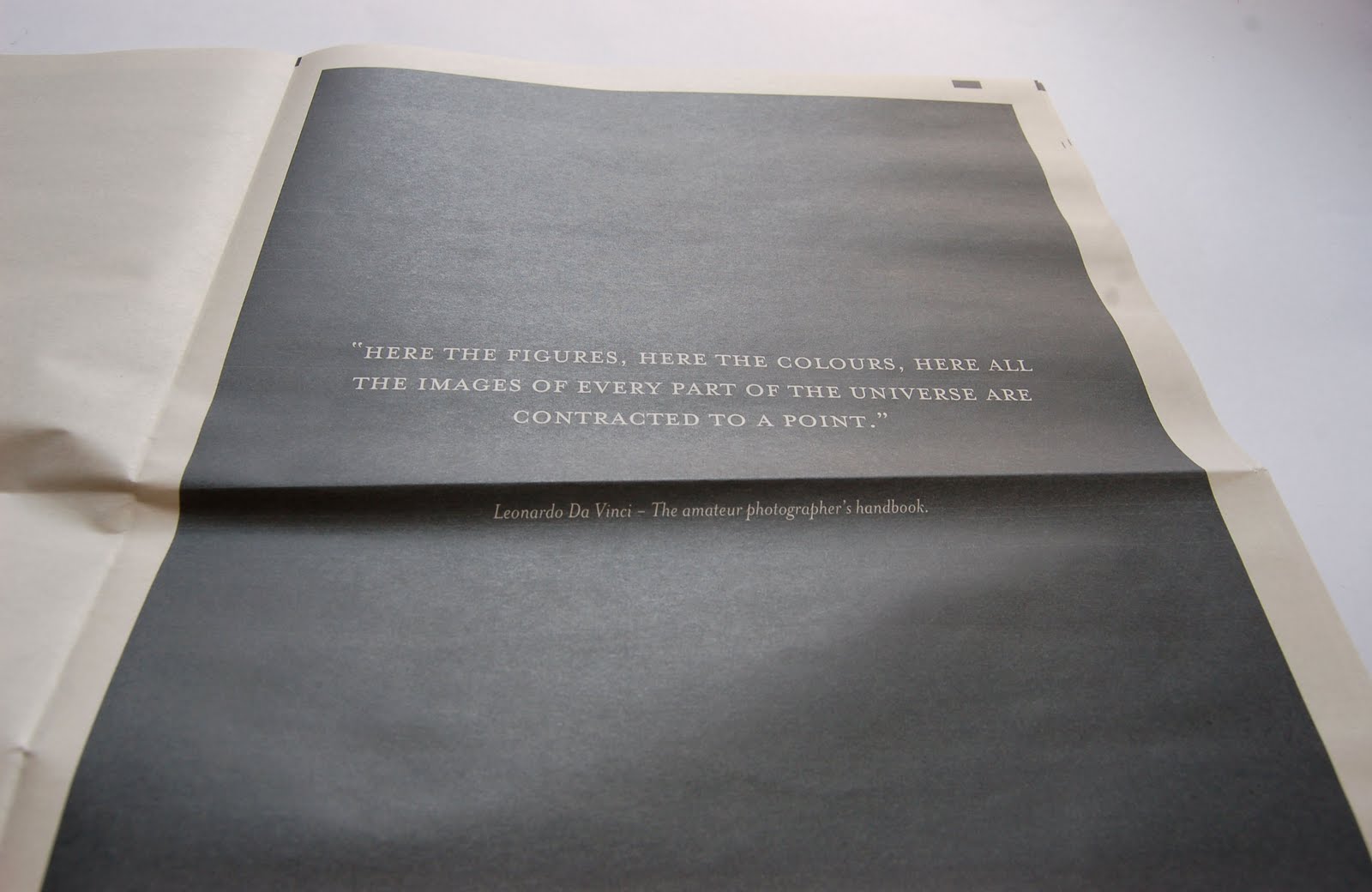
Black Squares

I decided to make a publication about the pinhole experiments from over the last semester. Where it took me a while to get used to the pinhole process, I quite often ended up with over exposed images. It became increasingly frustrating! I looked online for some pinhole quotes and used a few from the film 'The Brothers Bloom' and photographed all the black squares I had collected. I used The Newspaper Club online to print my newspaper, it was really quick and easy and I'm pleased with the result.


Motion in a single Pinhole Image

Another strand of my self directed study is trying to create motion in a single image. This has stemmed from my '1 hour pinhole' project where I tried to condense a film into a single image. I wanted to recreate this project looking at interactions with cameras. 

Below is the experiment I photographed using my pinhole can cameras. To create motion in the single photograph I asked different people to look at my roliflex camera and figure out how to use it. This was successful and I ended up with ghostly photographs of the figures moving with the roliflex camera. 


Friday

Pinhole Stop motion

As part of my self directed study I have chosen to make a stop motion animation using pinhole photography. This is something I haven't come across yet so thought it would be a challenge. 

I used my coca cola pinhole cans to take the photographs and had to photograph in the studio to get a clean white backdrop. This meant that the lighting was darker and I had to expose the photos for 3minutes each! This took all day in the studio probably about 8 hours! 

I then had to develop them in the darkroom, scan them and edit them on the computer before animating them. I am about to design a backdrop for the animation using flash, will blog when its all complete. Hopefully it will be worth all the effort!


Thursday

Five Minutes to Five Seconds

Five minutes to five seconds is a pinhole camera exposure experiment. Using hand made pin hole cameras from coca cola cans, the photos were exposed on a windowsill ledge from five seconds and increasing in time up to five minutes. 

As a result I found this grid shows the gradual development of a photo. Yesterday I got the chance to go to screen printing, this is usually always booked up but luckily we were able to squeeze in. The posters look much better on larger paper and I have used a dark blue colour for the prints.
Windowsill, Sunny, 11/02/11.


Black Squares

As part of my self directed study I am looking at pinhole photography. I have made my own pinhole cameras using cans and I intend to create a stop motion using the images from them. So far I have produced several tests to see if it is possible to create motion from pinhole photos and it hasn't been going too well. It has been quite bright and sunny recently which meant I was exposing the images for only 2 seconds each! Surprisingly a lot are still over exposing, which means I have a large selection of black squares now! I want to design something with them, they look quite interesting laid out in this grid.


Friday

Waterfront Prints

For this test i exposed the images in 2 second increments up to a 16 second exposure. The results were much better and the photos developed a lot clearer. My next project will involve making pinhole cameras using 35mm film. I want to experiment with colour leaks.

Waterfront Exposures

I have used my pinhole can cameras to redo the exposure experiment in a new location. I chose to photograph the river, as this is another risky place to leave a digital camera. I had quite a few odd looks from passers by as i placed a dozen coca-cola cans on the water front.

5 minutes to 5 seconds

I have designed posters to layout my pinhole exposures. The photos at the top of the page were exposed for 5 minutes, where as the photos at the bottom were exposed for 5 seconds. This shows the gradual development of the photographs and acts as a contact sheet ti show the best exposure time. I intend to develop this further and screenprint my posters on larger sheets using different colours.

Montpelier Bridge Exposures

My second pinhole can camera experiment was on a ledge at the montpelier station bridge. I chose this location as it is running with my theme of placing cameras in risky places. Digital cameras are much more precious therefore i can really experiment with where i leave my pinhole cans. The exposures are a tests and run from 5 minutes to 5 seconds.

Saturday

Coca-cola pinhole test

I went to the dark room at uni yesterday to test out my Coca-cola pinhole cameras. I was pleased that the results were much better than my first attempt using film and a paper pinhole cameras. These images were exposed for around 10seconds each as it was a really sunny day. The images were taken on a windowsill looking down at the uni library, the pinhole allows for an extra wide angle of 160° plus, and you can even see some of the windowsill either side.


Friday

Too bubbly

Been drinking a ridiculous amount of coke recently.. just kidding! I'm in the process of turning these cans into pin hole cameras. Going in to the dark room at uni tomorrow to put in the photographic paper and then test them out. I hope this works better than my first attempt using film. Oh and of course Toulouse had to jump in the way of the photos as she is such an attention seeker!

Tuesday

Pinhole Film

I put 35mm film into one of my paper pinhole cameras yesterday. I used an empty cannister to feed the film through and taped it all up with insulation tape. Tested it a few times today but it doesn't feel like the film is going through properly. Oh well, only time will tell. Will try to process the film tomorrow.

Making more Cameras

I have been building more paper pinhole cameras for my self directed study recently. They have come out much better this time as I had more practice and used thicker paper. I have film ready to test tomorrow. Fingers cross they work as well as they look! You can download the templates at the corbis.readymech website.


Wednesday

Paper Pinhole Camera

My first attempt at making a pin hole camera from a paper template was very confusing. The instructions were not very easy to follow and I made a few mistakes. Now that I have built one I know a bit more about the building process and can attempt to make another more successful camera. 

The template is very small which meant it was very fiddly to work with. I want to use thicker paper next time. I haven't loaded the film into this camera as I think the film will be fogged by the light coming through the rips in the paper. I want to practice building the cameras a bit more before I attempt to create photographs. 

Heres the link to the corbis readymech website where I downloaded the template. 
http://corbis.readymech.com/en


Sunday

Justin Quinnell

Photographer Justin Quinnell is a pinhole camera expert. This image is of the Clifton Suspention Bridge and was captured using a pinhole camera made from an empty can and a piece of photographic paper. This beautiful photograph was taken with one of the longest-ever exposures over a period of 6 months! The arcs of light show the movement of the sun through the winter and summer months. I really love the pinhole camera effect and Justin Quinnell's work is stunning.

Another project he worked on was called mouth piece. Justin Quinnell made a pinhole camera that fits inside your mouth. The photos are really facinating and looks at the world from a different perspective. To look at more of his work lok at his website www.pinholephotography.org you can even buy your own 'smiley cam' to take photos from inside your mouth!